PODCAST EPISODE 210
AI-Generated Content Could Keep Your Blog Out of Google
Google's original name was Backrub, built around the idea of backlinks. That history still explains a lot about how the search engine values connections and trust. It also sets up a more current question worth asking if you run a blog: does using AI to write your content put you at risk with Google.
Does AI-generated content hurt your Google rankings?
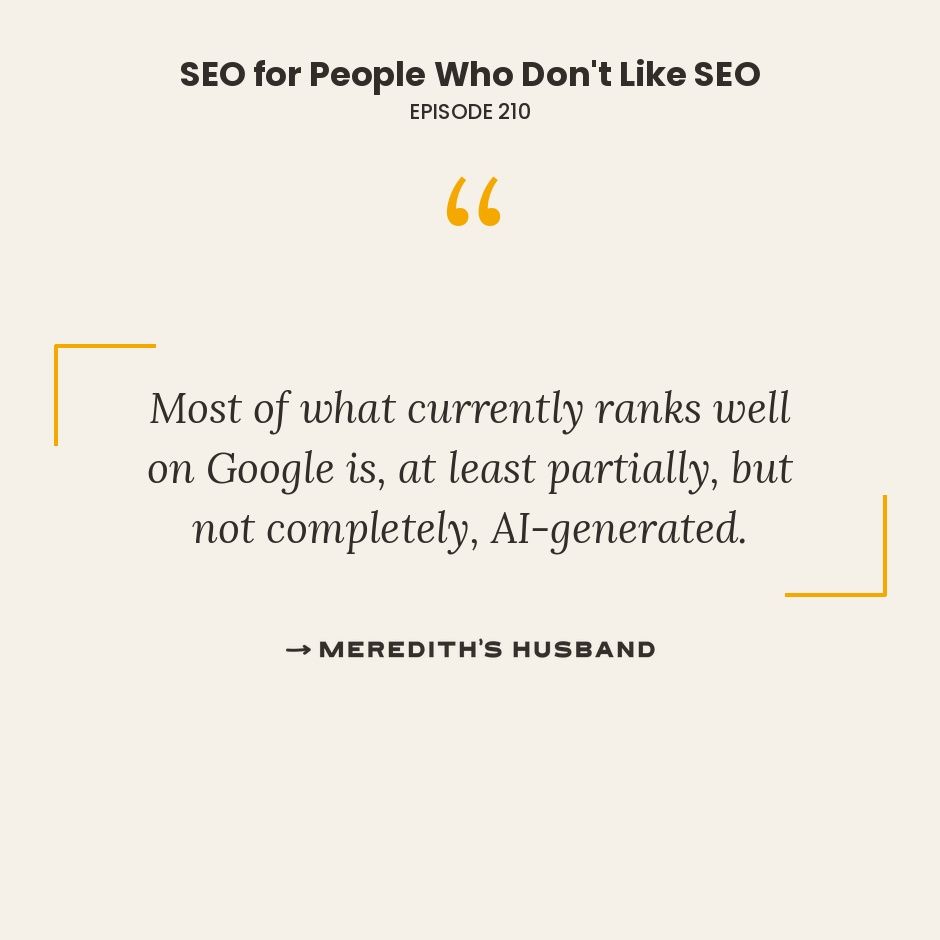
AI use on its own is not the problem. Most content that already ranks well on Google today is at least partially AI-generated, so the presence of AI is not what triggers a penalty.
The real shift is happening at a different stage. Google is becoming more selective about what even enters its index, not just what ranks well once it is there. Content that shows no trace of a specific person's experience is more likely to be filtered out before ranking ever becomes a factor.
What is AI content watermarking?
AI content watermarking is a method of embedding an identifiable pattern into AI-generated text or images. The pattern is not visible to a human reader, but other AI systems can detect it.
Google has already implemented watermarking on content its own tools generate. Anthropic has announced plans to do the same. OpenAI initially said it would follow the same approach, then reversed that position without much public explanation.
Rewriting or retyping AI-generated text does not guarantee the watermark is removed. The exact mechanism behind the fingerprint is not publicly known, so there is no confirmed way to strip it out.
Why are companies sending updated terms of service emails?
A wave of updated terms of service and privacy policy emails has gone out from major platforms recently. The language in these emails is often vague, but the underlying pattern points to companies limiting their liability for AI-generated content on their platforms.
Social media platforms have also started tagging profiles that are entirely AI-generated characters or entities. This labeling requirement is a separate but related response to the same shift in how much AI-generated content now exists online.

How is Google getting stricter about what enters its index?
Indexing is the step before ranking. A page has to be included in Google's index before it can show up in search results at all.
Pages that used to get indexed without issue are now being left out entirely. This is a change in inclusion, not just visibility, and it appears to track closely with the growth of AI-generated content across the web.
What can small business owners do to protect their blog content?
The most reliable response is to avoid relying on a simple AI prompt to generate a finished blog post. Content built this way is becoming easier to identify as fully AI-generated, and that identification may be enough to keep it out of Google's index.
- Write from your own perspective and your own experience with the topic
- Include specific facts, figures, names, and dates whenever possible
- Add details that reflect direct knowledge of your own clients or work
- Use AI to support the writing process, not to generate the finished piece on its own
Concrete, specific detail is not something AI systems generate well on their own. Including it consistently is one of the more effective ways to keep a blog post identifiable as human-written and eligible for Google's index.

What should you take away from this?
This area is still developing, and the exact detection methods behind watermarking are not public. What is clear is that content built entirely from a generic AI prompt carries more risk than it used to, specifically at the indexing stage rather than the ranking stage.
Writing from direct experience and including concrete, specific detail remains the most dependable way to keep a blog post visible in Google, regardless of how AI detection methods continue to change.

Become an Insider
Thank you!
Check your inbox for confirmation
Get the SEO+AI Primer
Check Your Inbox!
Pleaase confirm your email address and receive the SEO+AI Primer course.
Check your INBOX and PROMOTIONS folders!