PODCAST EPISODE 213
How to Do SEO When You Don't Want To | Meredith's Husband
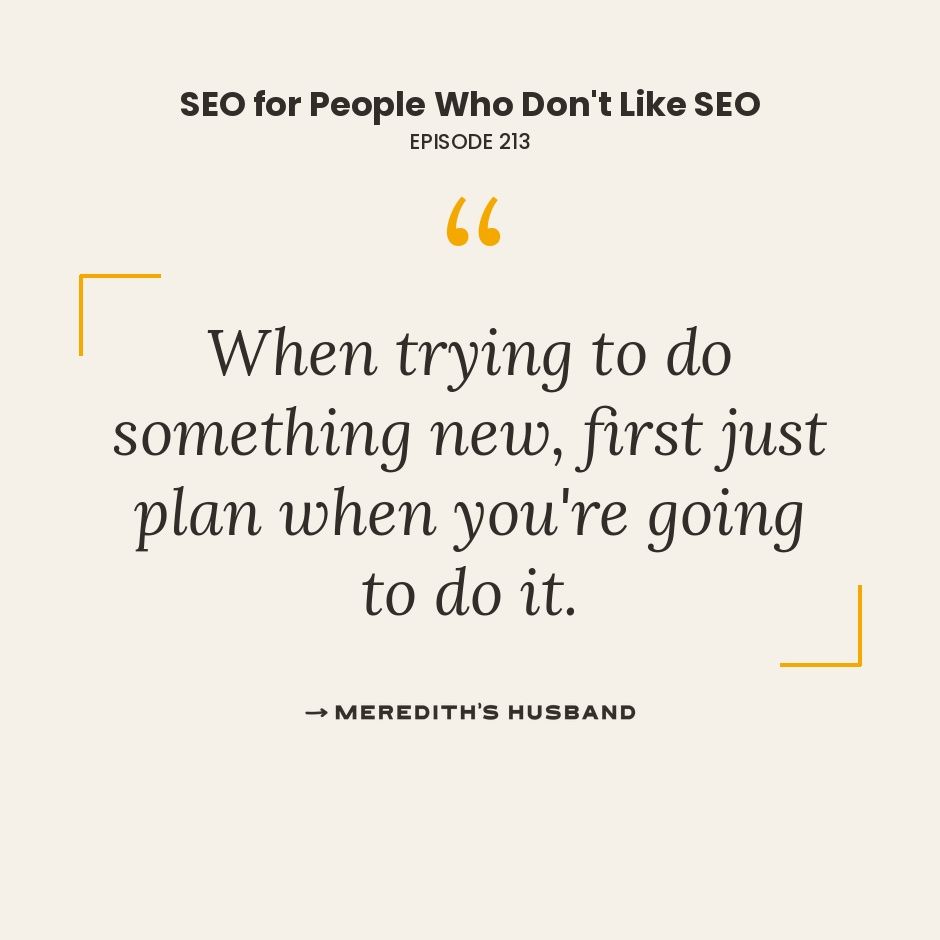
How do you do SEO when you don't want to?
The most reliable way to do SEO when the work feels unappealing is to make the first step so small that skipping it is hard to justify. SEO tasks such as writing image alt tags, title tags, and meta descriptions, doing keyword research or competitor research, and publishing blog posts often sit at the bottom of a to-do list. A task at the bottom of the list moves to tomorrow, then to the next day, and the pattern repeats.
Three habits help break that pattern. Each one applies to any SEO task, and to any task that feels like something you should be doing but don't want to do.
- Start ridiculously small.
- Begin with scheduling.
- Treat the small step as a win.
Why does starting ridiculously small work better than breaking a task into chunks?
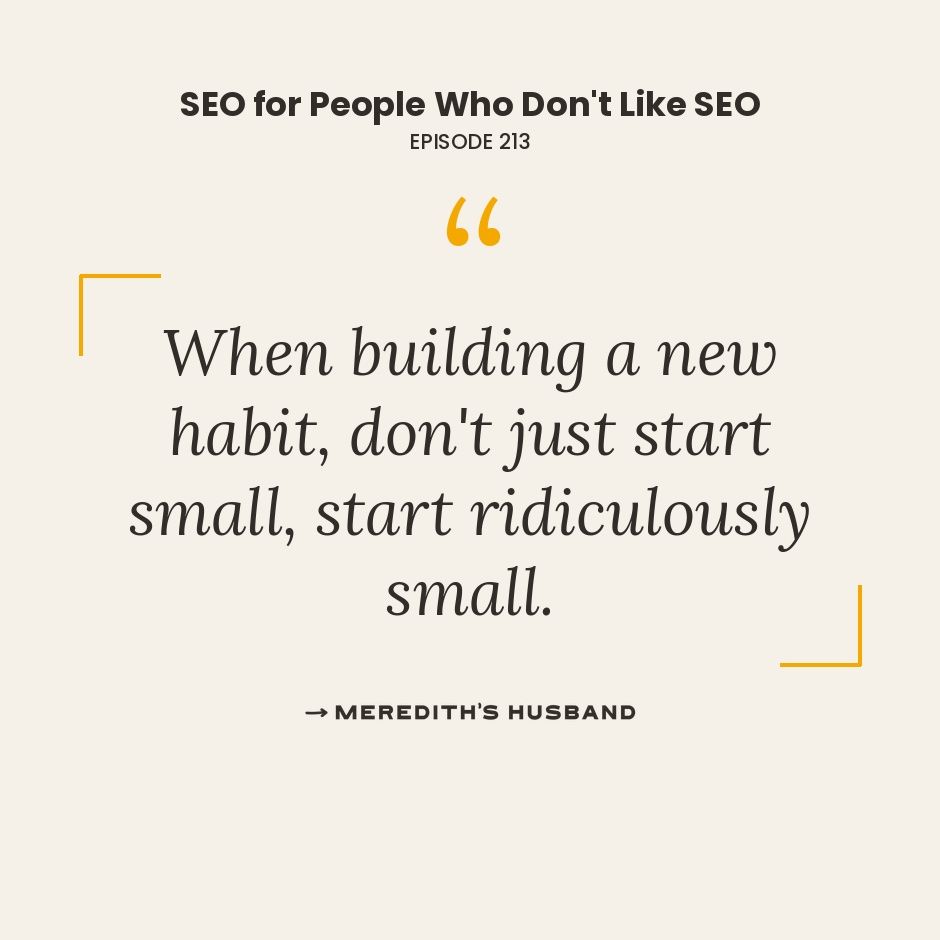
Starting ridiculously small works better because a chunk of a large task is still a large task. A job expected to take two hours does not become easy when it is split into half-hour sessions, since each session still asks for half an hour of something unwanted.
Writing image alt tags is a common example. The first step is to open your website and look at it. The second step is to log in and go to one page that needs alt tags. Each of those steps takes seconds, and each one counts as progress.
A gym example shows the same idea. Someone who wants to start going to the gym but never does can begin by placing gym shoes by the door. The next step might be putting the shoes on and walking outside, and the step after that might be a walk around the block. The first action requires almost no effort, which is the point.
Why should a small step count as a win?
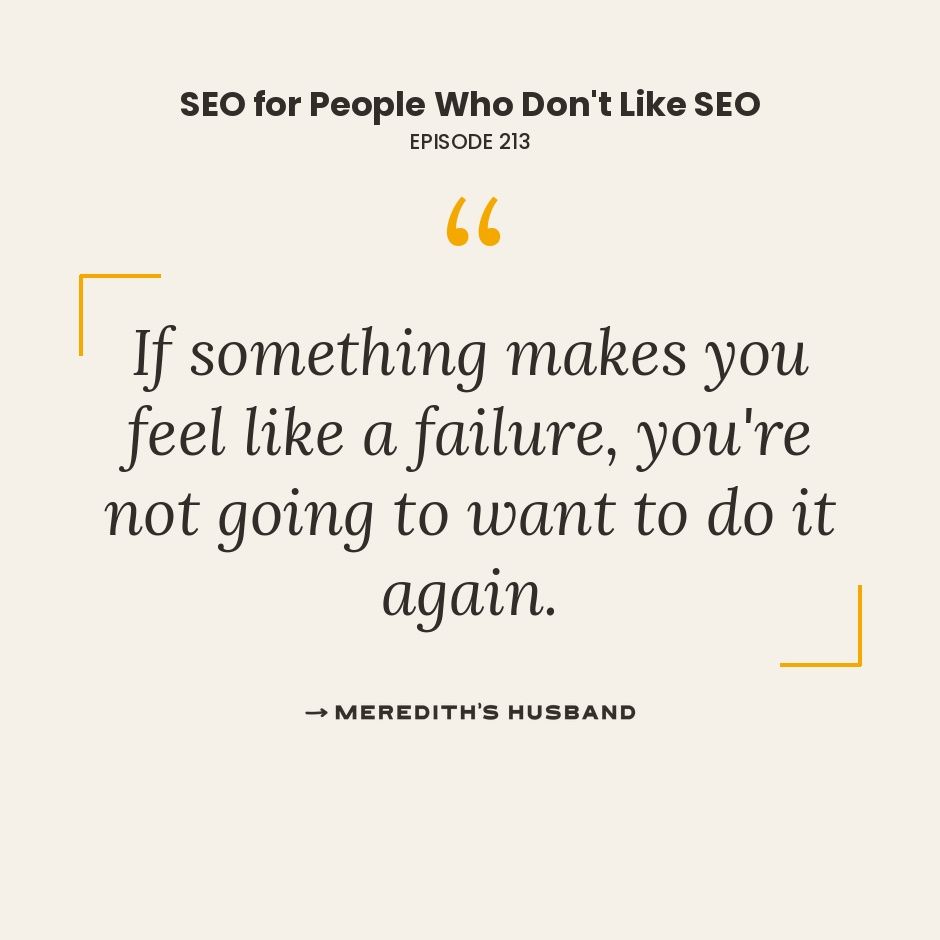
A small step should count as a win because feeling like a failure makes a task less likely to happen again. Finishing something minor can still feel like falling short, since the step was small only because the real work did not get done. A task that produces that feeling becomes a task to avoid.
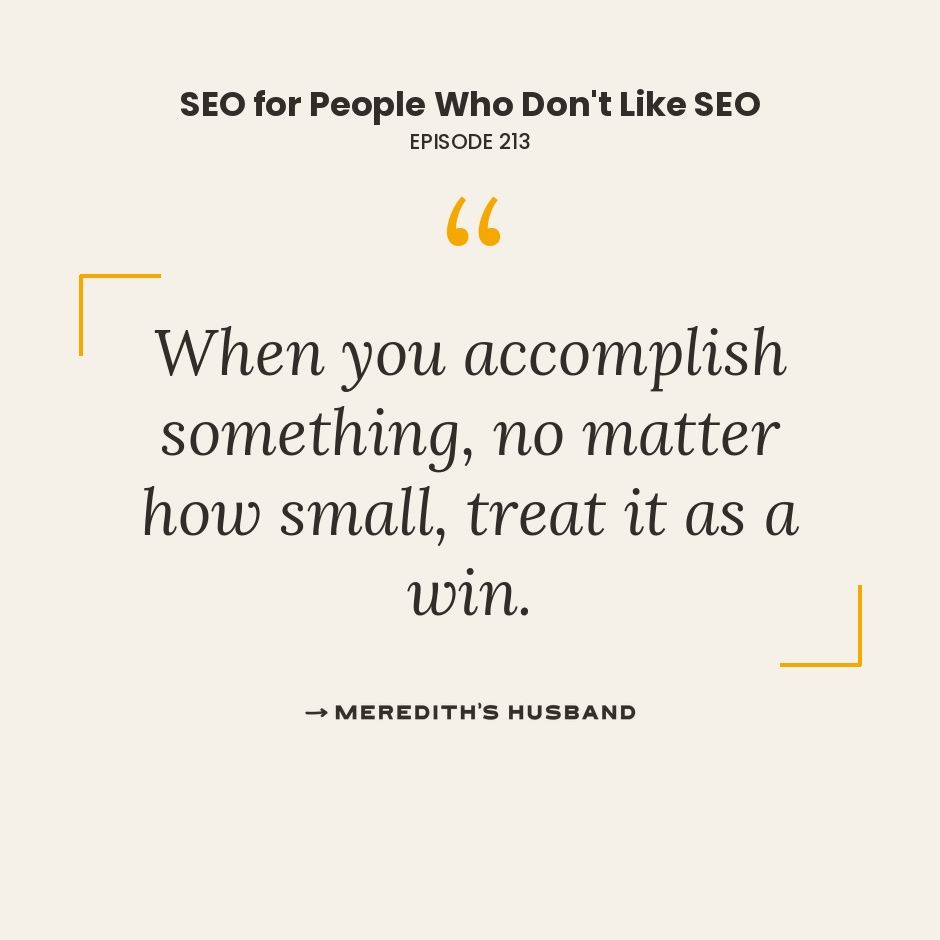
Reframing the outcome changes the pattern. Deciding to do something and then doing it is an accomplishment, no matter how small the action. Ending the day with that sense of accomplishment, instead of focusing on what remains on the list, builds the confidence needed for the next goal.
Can a habit you enjoy help you build an SEO habit?
Yes, setting goals in an area you enjoy can make SEO habits easier to build. Confidence from one area carries over to another, even when the two areas are unrelated. Someone who is good at sports and fitness, for example, can practice setting a goal, scheduling it, and completing it there.
Seeing that sequence work in an enjoyable area makes the same sequence easier to trust when the task is SEO.
What is the first habit to build?
The first habit to build is sharing feedback on this episode. Listeners can use the link in the show notes to say whether they liked or disliked episode 213, and the episode number should be included so the host knows which episode the feedback refers to. That feedback shows which types of episodes listeners appreciate, so more of them can be made.
Resources
- Episode 213 feedback link (in the show notes)
How do you do SEO when you don't want to?
The most reliable way to do SEO when the work feels unappealing is to make the first step so small that skipping it is hard to justify. SEO tasks such as writing image alt tags, title tags, and meta descriptions, doing keyword research or competitor research, and publishing blog posts often sit at the bottom of a to-do list. A task at the bottom of the list moves to tomorrow, then to the next day, and the pattern repeats.
Three habits help break that pattern. Each one applies to any SEO task, and to any task that feels like something you should be doing but don't want to do.
- Start ridiculously small.
- Begin with scheduling.
- Treat the small step as a win.
Why does starting ridiculously small work better than breaking a task into chunks?
Starting ridiculously small works better because a chunk of a large task is still a large task. A job expected to take two hours does not become easy when it is split into half-hour sessions, since each session still asks for half an hour of something unwanted.
Writing image alt tags is a common example. The first step is to open your website and look at it. The second step is to log in and go to one page that needs alt tags. Each of those steps takes seconds, and each one counts as progress.
A gym example shows the same idea. Someone who wants to start going to the gym but never does can begin by placing gym shoes by the door. The next step might be putting the shoes on and walking outside, and the step after that might be a walk around the block. The first action requires almost no effort, which is the point.
Why should a small step count as a win?
A small step should count as a win because feeling like a failure makes a task less likely to happen again. Finishing something minor can still feel like falling short, since the step was small only because the real work did not get done. A task that produces that feeling becomes a task to avoid.
Reframing the outcome changes the pattern. Deciding to do something and then doing it is an accomplishment, no matter how small the action. Ending the day with that sense of accomplishment, instead of focusing on what remains on the list, builds the confidence needed for the next goal.
Can a habit you enjoy help you build an SEO habit?
Yes, setting goals in an area you enjoy can make SEO habits easier to build. Confidence from one area carries over to another, even when the two areas are unrelated. Someone who is good at sports and fitness, for example, can practice setting a goal, scheduling it, and completing it there.
Seeing that sequence work in an enjoyable area makes the same sequence easier to trust when the task is SEO.
What is the first habit to build?
The first habit to build is sharing feedback on this episode. Listeners can use the link in the show notes to say whether they liked or disliked episode 213, and the episode number should be included so the host knows which episode the feedback refers to. That feedback shows which types of episodes listeners appreciate, so more of them can be made.
Resources
- Episode 213 feedback link (in the show notes)

Become an Insider
Thank you!
Check your inbox for confirmation
Get the SEO+AI Primer
Check Your Inbox!
Pleaase confirm your email address and receive the SEO+AI Primer course.
Check your INBOX and PROMOTIONS folders!