PODCAST EPISODE 200
Build an AI Engine to do your SEO
Can Claude or ChatGPT Do My SEO for Me?
The question comes up constantly. Can you just open Claude or ChatGPT, ask what to do for your SEO, and follow the advice? The short answer is yes, you can do that. The more complete answer is that there are three significant problems you need to understand before you do.
Why Does AI SEO Advice Sound So Convincing?
The first problem is that AI delivers every answer with the same tone and the same level of confidence, whether the advice is correct or catastrophically wrong. There is no signal that tells you which is which.
Claude does not hedge. ChatGPT does not flag uncertainty. Gemini does not warn you when it is working from outdated information. Every response sounds like the definitive answer from someone who knows exactly what they are talking about.
That is a real problem when you do not yet know enough SEO to evaluate what you are being told.
What Does Garbage In Equal Garbage Out Mean for SEO?
The second problem is the garbage in, garbage out principle. Anthropic did not train Claude to be an SEO expert. OpenAI did not train ChatGPT to do SEO. Google did not train Gemini specifically for SEO.
These tools learned what they know about SEO by pulling from the public internet, which means they learned from the same blogs, forums, and articles available to anyone doing a search. If a portion of that content is outdated, inaccurate, or outright wrong, that information gets passed along as advice with no filter and no warning label.
Here is a real example. A student asked Claude how to hide a block of text from website visitors while keeping it visible to Google. Claude's suggestion: make the text the same color as the background. White text on a white background. Visitors would not see it, but search bots would.
That technique was used in 2006 and 2007. It worked briefly. Today it is one of the clearest spam signals a website can send to Google. Google detects this easily, and it is the kind of thing that can get a site removed from search results entirely, not just demoted.
The student followed the advice. The issue was caught and corrected in time, but only because it came up in a separate conversation. That is what it looks like when garbage goes in and comes back out as authoritative advice.
Why Can't AI Give You a Real SEO Strategy?
The third problem is that even when AI gives you technically reasonable advice, it is not giving you a strategy. It is giving you individual tips with no framework connecting them.
Think about photography. If someone who has never used a camera asks how to get a sharp image, you could give excellent advice about focus. But if the f-stop is wrong, the shutter speed is off, and the lighting is poor, that image is not going to work. Good advice on one element does not produce a good result when the other elements are ignored.
SEO works the same way. A few correct tips, delivered without context and without a larger plan, do not add up to a functioning SEO strategy.
Is AI Going to Replace SEO Professionals?
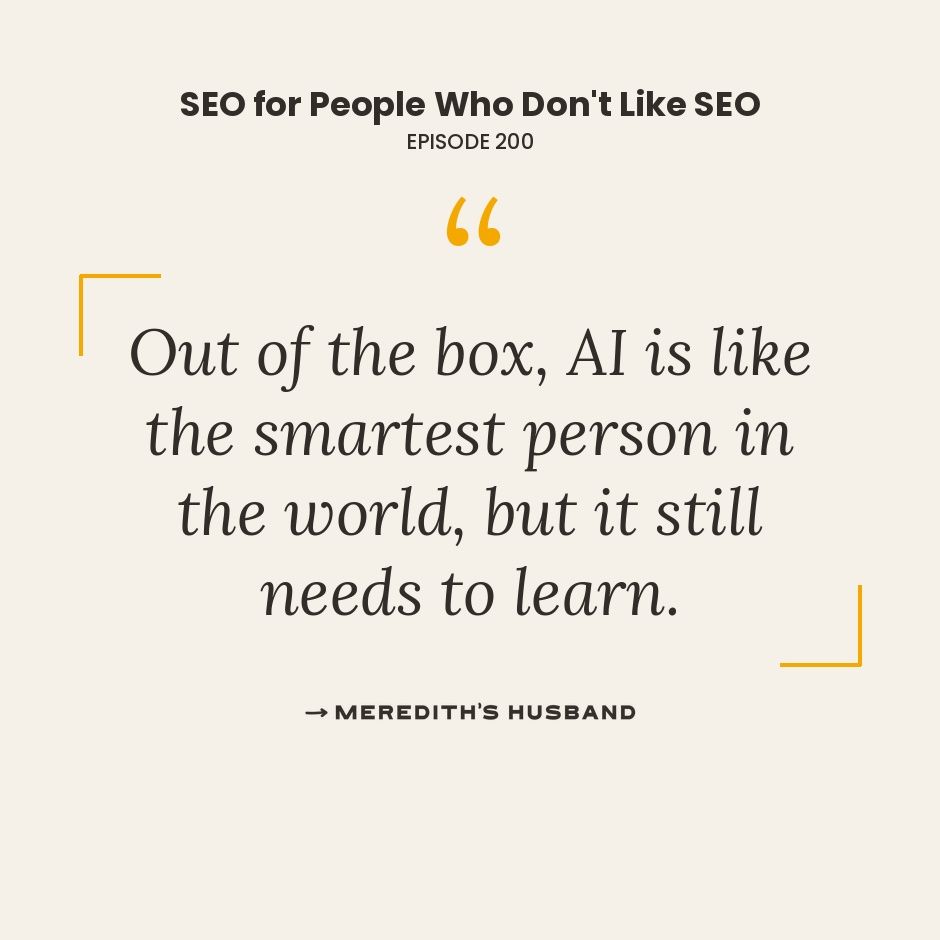
The industry is already answering this question in practical terms. The focus in AI development has shifted from prompt engineering, which had a brief moment and faded fast, toward training. Companies are now hiring people specifically to feed accurate, domain-specific information into AI models so those models can perform specialized work reliably.
This is already visible in industries like programming. Companies that once needed hundreds of developers are now operating with a fraction of that number, because a small team that knows how to direct AI can do the work that previously required a much larger staff.
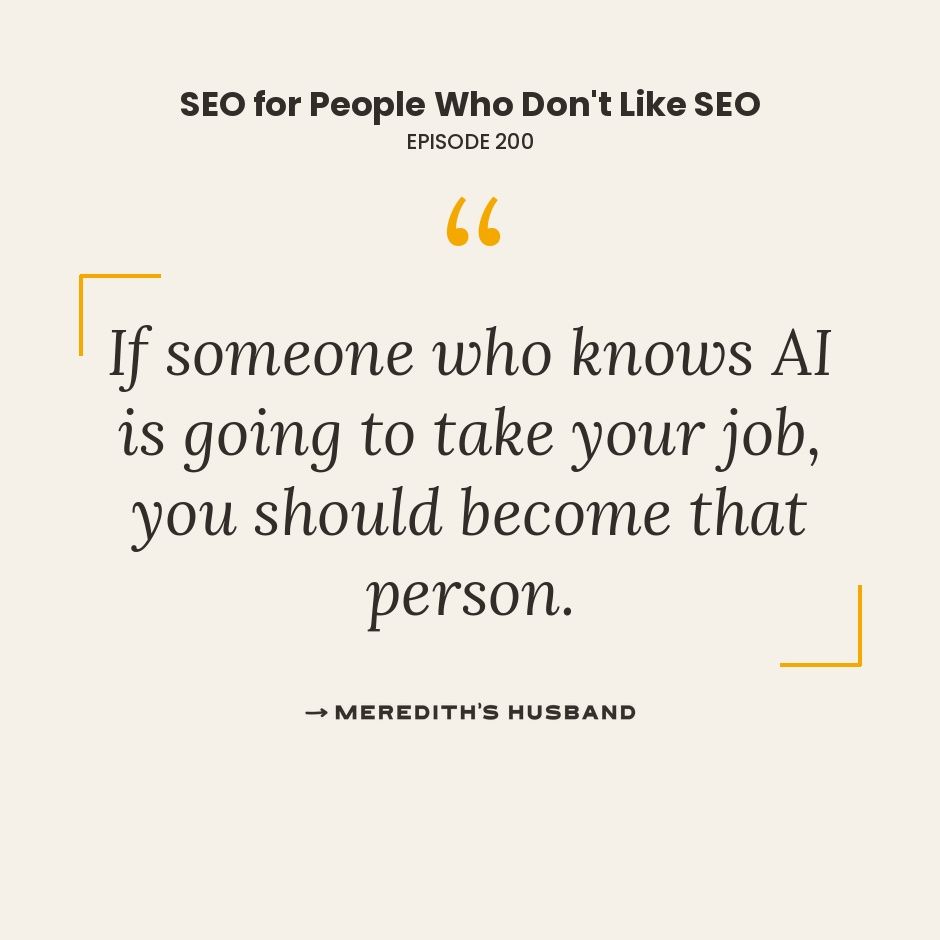
Sam Altman put it plainly: AI is not going to take your job, but someone who knows how to use AI will.
What Does a Trained SEO AI Actually Look Like?
The answer to all three problems is not to avoid AI. It is to use AI that has been trained on accurate, strategic SEO knowledge rather than whatever happens to be floating around online.
That means two things working together:
- A vetted knowledge base: accurate SEO information built from real expertise, not scraped from random sources.
- A strategic framework: a structured process that tells AI what to address, in what order, and based on what conditions.
Think of the Choose Your Own Adventure books. You move through a structured process, and at each decision point the framework directs you based on what you actually find, not what a generic response assumes.
That combination solves all three problems. The knowledge base removes the garbage input. The framework adds strategic context. Together they replace the false confidence of an unguided model with something you can actually rely on.
The answer to the question is not no. It is not yet, not without the right input and the right strategy behind it. That is exactly what is being built.

Become an Insider
Thank you!
Check your inbox for confirmation
Get the SEO+AI Primer
Check Your Inbox!
Pleaase confirm your email address and receive the SEO+AI Primer course.
Check your INBOX and PROMOTIONS folders!